On average, 35% to 50% of leads generated by digital ad campaigns do not answer the phone calls made within the first 48 hours. These “silent” leads (No-Response Leads), already paid for out of the ad budget, quickly slide into the “cold lead” category.
So are these prospects genuinely uninterested, or were they simply reached at the wrong time through the wrong channel?
1. Why Don’t Prospects Respond?
Before designing a recovery strategy, you need to analyze the behavioral root causes:
- Unknown Number Aversion: Unrecognized calls to corporate or personal mobile phones are routinely blocked.
- Timing Mismatch: The call lands in the middle of the prospect’s meeting or a peak-workload moment.
- Channel Preference Errors: Next-generation buyers prefer messaging (WhatsApp/email) over phone calls.
2. The 4-Step Automated Recovery Sequence
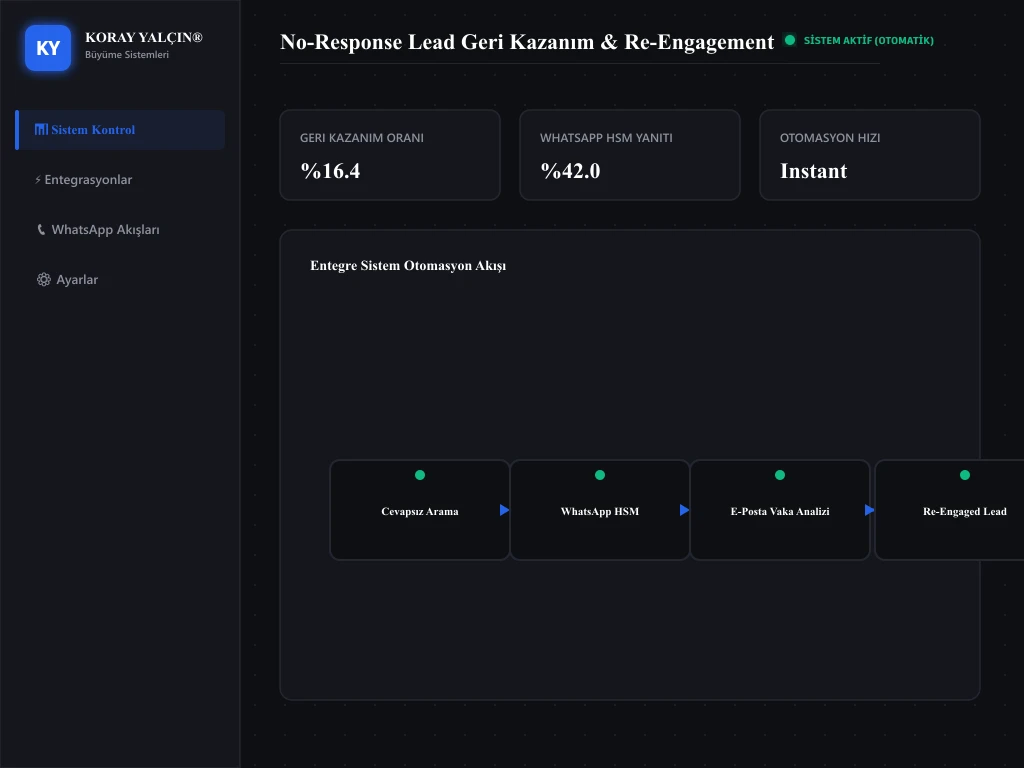
Leaving the recovery process to a sales rep’s manual follow-up is a waste of time. Instead, the following automated flow is put in place:
- Day 0 (Inquiry Moment + 15 min): When the call goes unanswered, an automated WhatsApp Welcome Message is sent (Template PDF & Booking Link).
- Day 2: Problem-Focused Value Email (Industry-Specific Case Study).
- Day 5: Micro-Survey / Question Message (“What stage is your process at? A) Evaluating B) Postponed C) Went with a Different Solution”).
- Day 10: Break-Up Message (“We’re closing your file—do you have any final questions?”).
graph LR
    A[Call Unanswered] --> B[WhatsApp HSM Sent]
    B --> C{Reply Received?}
    C -- Yes --> D[Notify Sales Rep]
    C -- No --> E[Day 2: Case Study Email]
    E --> F[Day 10: Break-Up Message]
💡 Conclusion and Recommendations
When the right automation scenarios are implemented, 12% to 18% of leads written off as “lost” are brought back into the active sales pipeline.
- To stop No-Response leakage in your company, you can request System Architecture Consulting.
Cite This Work
APA 7th