Executive Summary
Construction and real estate projects involve investments worth millions of dollars, yet the prospect data that drives the return on those investments is often kept in Excel spreadsheets or on sales reps’ personal phones. In this article, we explain why CRM is mission-critical for construction companies.
Who Is This For?
Owners and executives of construction companies who want to move their sales and follow-up operations from Excel to professional software.
Key Concepts
- CRM (Customer Relationship Management): A centralized software platform used to manage relationships with customers and prospects.
- Data Fragmentation: The practice of sales reps storing customer information in their own notebooks or personal files.
- Cloud Database: Secure access to up-to-date data from anywhere with an internet connection.
The Problem
When a sales rep leaves the company, their entire portfolio and every warm, in-progress conversation leave with them. Keeping Excel lists without password protection leads to data leaks. And because there is no record of whom a customer previously spoke with or which unit they were interested in, no institutional memory can take shape.
Analysis
Construction companies that use CRM see conversion rates per sales rep increase by 25%. Reservation and contract documents generated automatically by the system keep sales teams from getting bogged down in paperwork and increase the time they can dedicate to customers.
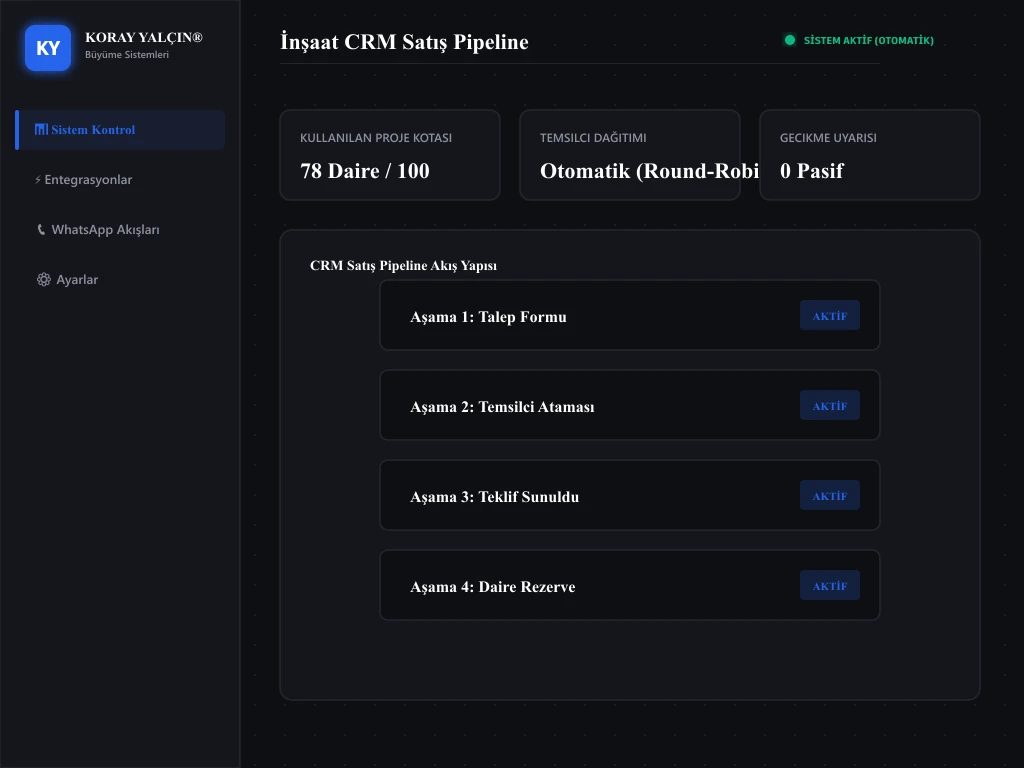
Recommended System
Construction Company CRM Starter Infrastructure:
- Centralized Database: All leads from Meta Ads, Google Ads, and websites flow into a single screen.
- Role-Based Permissions: Sales consultants see only their own customers, while managers can monitor the entire lead pool.
- Inventory Integration: An interactive floor plan module showing which units have been sold and which are still available is connected to the CRM.
Implementation Steps
- Step 1: Choose a CRM that fits your needs. When digitizing your processes, conducting a needs analysis and selecting the right software vendor are critical steps. Before making a decision, you can review the step-by-step selection methodology in this detailed guide to choosing a CRM (in Turkish).
- Step 2: Clean up your legacy portfolio and customer lists in Excel (data deduplication) and import them into the system.
- Step 3: Set up a CRM-integrated virtual PBX (VoIP) system so that phone calls can be logged and recorded.
Cite This Work
Yalçın, K. (2026). What Is CRM and Why Does It Matter for Construction Companies?. KorayYalcin.org Publications & Research.
Sources
Salesforce and enterprise CRM analyses.
Related Articles
Let’s Work Together
Get in touch to have your CRM and lead system assessed. To retire your Excel-based processes and build an enterprise-grade CRM infrastructure, you can book an appointment via the Contact page.